Despite the recent drops in nighttime temperatures in the Wasatch Back that threaten to take out our tomatoes and basil and the orange leaves on the northern slopes of the Wasatch, I maintain that summer is not over! I’m a self-admitted lover of warm weather and summers. With COVID, it was hard for many of us to escape to somewhere wonderful and to enjoy a summer vacation this year, so I’m indulging in a fantasy week at a seaside cottage.
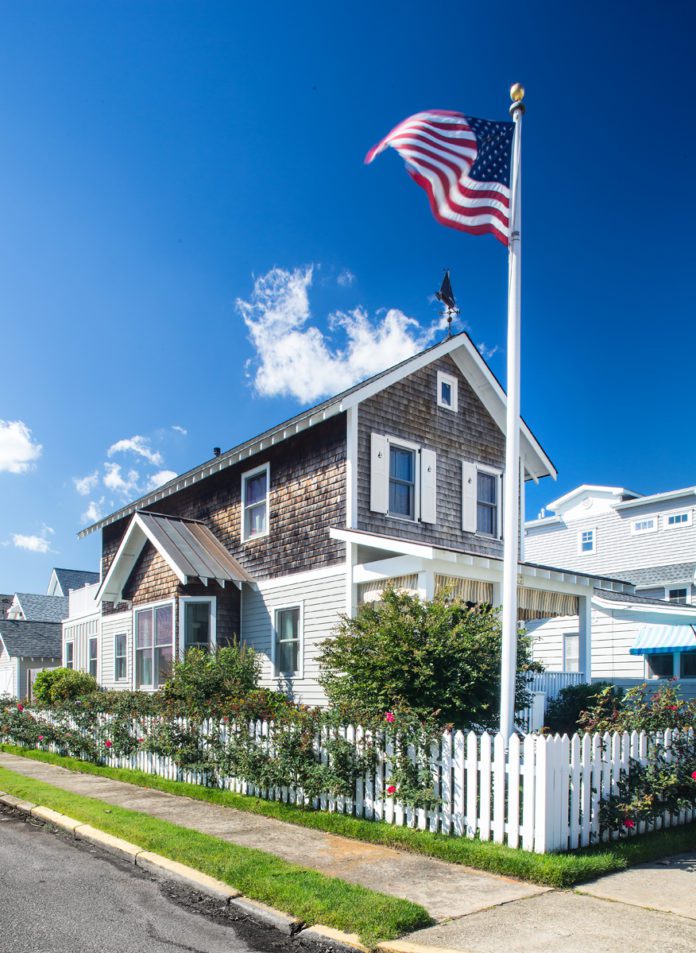
Photo by Scot Zimmerman
The rocking wicker chairs look out to the Atlantic in Manasquan, New Jersey. The beach is wide and sandy, and in addition to sunning and chasing frisbees, people are out swimming, surfing, fishing, boating and sailing. Manasquan holds the distinction of being the northernmost point of the Inland Waterway.
I met Tom Bateman of Imagineered Homes when I photographed homes for The Coastal Cottage, a book written by my trusted photo assistant, Ann, and published by Gibbs Smith in 2017. Tom and his team designed and built this and a number of other homes in the book, and Tom and Cathy Bateman lived in this one for a period of time.
Photo by Scot Zimmerman
The living room represents a mastery of living well in a small space. The white board and batten walls and open-beamed ceiling make the room feel larger and airier. The Maine Cottage furniture adds bright hues reminiscent of summer sherbets, and the ships, fish-motif accessories, and oar curtain rods are a reminder of place, even if you are shut in during a summer rain.
Photo by Scot Zimmerman
Continuing through the home, the dining room looks out three windows. It is a part of an open plan with the living room. The painted green floors were difficult to see in the living area shot, but continue through. The home is on a corner lot, and the design had to address the proximity of the adjacent neighbor and maintained privacy between the two by eliminating windows on that side. The ample windows on the opposite side compensate for the loss of light.
Photo by Scot Zimmerman
The kitchen is another interesting use of space. It cuts across the width of the home in essentially a long hallway with a door to the outside to form an efficient galley kitchen. For more light, there is a transom above the door with its glass window.
Photo by Scot Zimmerman
Moving upstairs, the painted floors transition to a deep red, but the walls and ceiling stay cottage white. The home office is “found space” in the bedroom hallway.
Photo by Scot Zimmerman
The upstairs bedroom’s furniture plays with tones of blue that work well, not unlike the blues of the sky and the sea.
This cottage offers my fantasy vacation: just enough space to be comfortable for a week. To top off my perfect imaginary week, I’ll return to the seafood restaurant on a pier that the Batemans introduced me to and again order macaroni and cheese with lobster. Consider it an Imagineered vacation!
Labor Day is right around the corner, which means we’re running out of time to try our favorite summer recipes. We have variations on a classic appetizer, two sweet side dishes and a dessert starring fresh berries. Say farewell to the season the right way by sharing these dishes at a holiday party (or—why not—eating them all on your own in one sitting.)
Four Delicious Deviled Egg Recipes
Photo by Adam Finkle.
Classic
Step 1:
Mash yolks from 6 hard-boiled eggs
Add 1/4 tablespoon mayonnaise (or yogurt)
1/2 teaspoon ground mustard
Pinch of salt, 1/4 teaspoon pepper
Directions:
Fill the halved egg whites with the yolk mixture.
Sprinkle with paprika
Bacon & Paprika
Begin with Classic recipe’s Step 1.
Directions:
Stir in 2 strips bacon, cooked and crumbled
Fill the halved egg whites with the yolk mixture
Sprinkle with paprika and garnish with a bacon bit
Wasabi & Unagi
Begin with Classic recipe’sStep 1.
Directions:
Stir in 1 1/2 teaspoons Chinese mustard, 1 teaspoon wasabi paste
Fill the halved egg whites with the yolk mixture
Top with unagi
Sriracha & Cilantro
Begin with Classic recipe’s Step 1.
Directions:
Stir in 2 Tablespoons chopped green onions.
Fill the halved egg whites with the yolk mixture.
Top with 2-3 stripes of Sriracha sauce; sprinkle with paprika and top with a cilantro leaf.
Grilled Produce
Think beyond the beef and go to your yard or the farmers’ market to get fresh-picked goodies for the grill. Here’s the tips you need to get started:
Cut fruit into large pieces so that it keeps its form as it heats up and doesn’t fall between the grates.
Use skewers and baskets to grill small fruits like strawberries, plums and kumquats.
Most fruits cook best with lower heat. Put them on the outside edges of your grill, not over the hottest spot.
Before placing fruit, heat grill to medium high for 10 minutes, then scrape and oil the grates.
Brush fruits with oil before grilling, and select a neutral-tasting oil that works with high heat, such as safflower and grapeseed oils.
Choose firm, not-overly-ripe fruit that will maintain its structure as it heats.
The natural sugars in the fruits require a lower cooking temperature to prevent the sugars from burning. For caramelized, but not burnt fruit, cook your fruits over indirect heat or wait until the coals begin to die out and the temperature is less intense.
To get grill marks and char, grill fruit over high heat for about 3 minutes without moving or flipping it (depending on fruit’s size and thickness). Turn and cook for another 1 to 3 minutes.
Have your meal ready to serve before you start grilling fruits and vegetables. They cook quickly and are best served right from the grill.
Try grilled fruit as a side dish with your main protein—pineapple and banana with fish, peaches with chicken, apples with pork.
Summer in a Cone
Cones aren’t just for ice cream. Today’s pros fill them with everything from berries to scrambled eggs, ahi tuna to lattes.
Crafting a Cone
Pour prepared batter into cone maker.
Allow batter to cook through (1-2 minutes) before removing from heat
Roll around form while still warm to shape the cone.
Cone Concoctions
Blend olive oil with softened feta cheese to the consistency of yogurt; top with halved cherry tomatoes, kalamata olives, slivered red onion and chopped cucumber.
Line cone with basil leaves. Toss mozzarella “pearls” with a tablespoon of chopped tomato and fill the cone. Top with toasted pine nuts and drizzle with EVOO and balsamic vinegar.
Fill cone with chicken salad made with toasted almonds and halved green grapes.
Layer thin slices of smoked salmon with dilled cream cheese and top with capers.
The Lowdown On Strawberry Shortcake
A proper strawberry shortcake is made with a slightly sweetened biscuit, and it only takes a few steps to perfection.
Biscuits
Directions:
Like pastry, the first step in making biscuits is mixing cold butter with flour, but the key is keeping the butter cold. You can do this with your hands if they’re cool and you work quickly. Better: Use a pastry blender.
You can also use a food processor, just be careful to pulse in short bursts so the dough doesn’t overblend. The mixture should be coarse with little cold lumps of butter.
Knead the dough very lightly. You don’t want to build up the gluten—it makes the biscuits tough.
Use a heavily floured pastry cloth to roll out the biscuits.
Roll out the biscuits with a light touch, using a silicone-coated rolling pin. Again, don’t over-work the dough.
Dip your biscuit cutter in flour to prevent it sticking.
Bake biscuits in a hot oven—400-450 degrees. Invest in an oven thermometer.
Strawberry Shortcake
It only takes a few more steps to turn your sweet biscuits into a scrumptious strawberry shortcake:
Directions:
Cut your strawberries in half and mix with sugar. Allow them to rest to get those juices out.
Split your trusty biscuit horizontally and layer with halved strawberries.
Obviously, you need whipped cream on top. Add a healthy dollop and serve!
Home by Jackson & Leroy. Design by Rochelle Warner. Architecture by McALPINE. Landscape architecture by Kaiser Trabue. Masonry by Artistic Stone Masonry. Photo by Joshua Caldwell.
Joshua Caldwell is a photographer who has contributed to our magazine, Salt Lake magazine, Phoenix magazine, Phoenix Home & Garden and The Perfect Bath. (Most recently, we published his jaw-dropping photos of a Holladay landscape in our summer issue.) Based in the Phoenix area, Caldwell has also shot in Utah, throughout the Mountain West and in Mexico. His wide range of clients include designers, builders, landscapers and architects. We talked with him about his career, his approach to photography and his unexpected favorite room to shoot.
USD: What inspired you to start interior and architecture photography?
Growing up, I was always building and creating things. Photography was not something that was really on my radar, although once in a while with a disposable camera I would try to make some interesting compositions. As I got a little older, I started meeting a few people who were taking art more seriously—painters, photographers—and so I started thinking, well, maybe there’s something I could do here.
Home by Brandon Leroy of Jackson & Leroy. Design by by Elizabeth Wixom and Kimberly Rasmussen of Establish Design. Architecture by Bradford Houston. Photo by Joshua Caldwell.
In college, I started studying architecture, actually, up at the University of Utah. I didn’t excel at math, but the creative side I really excelled at. I started turning more to the design side, so I transferred over to the art program. One of my architectural design professors mentioned architectural photography, and I hadn’t really considered it before. Photography in general was a good fit for me because it seemed like a central hub in lots of different things that I was interested in. It’s utilized in painting and drawing, it’s utilized in film, it’s utilized in architecture and design. I could be part of the architectural process and then document it, and that really got me excited, because I didn’t want to give that up entirely.
Home by Jackson & Leroy. Design by Anne-Marie Barton. Cabinet by Teerlink Cabinet. Unlacquered brass hardware by Waterworks. Stone from European Marble & Granite. Photo by Joshua Caldwell.
USD: Along with photography, you have worked in other artistic mediums. Do you approach these projects differently? How has working in different art forms influenced your photography?
I have always been doing my own projects, my own fine art projects. It’s something that I’m always working on or thinking about.
THE. Painting by Joshua Caldwell.
Photography has ended up playing a really important role in those things. In fact, I have a hard time sometimes visualizing a painting—I actually have to have to sometimes take a photograph of the scene in order to set these boundaries and figure out my composition. The photograph becomes a useful reference for figuring out values and the tone of the painting. The biggest influence on me, outside of looking at other photographs, is paintings and drawings and seeing how things are composed and how light is captured and rendered.
2Directions. Painting by Joshua Caldwell.
USD: What else influences your photography?
I am an architectural photographer, but more importantly I identify myself as an artist. I actually use my Instagram a lot as a way to explore visual things. It could be color, it could be shape, it could just be something interesting that makes me stop and look at something, like the way a shadow falls across the grass or the way the sun was setting. I’ve had certain clients tell me, “We liked seeing that you were aware of your surroundings.” To me, that awareness is really important.
Home by Brandon Leroy of Jackson & Leroy. Design by by Elizabeth Wixom and Kimberly Rasmussen of Establish Design. Architecture by Bradford Houston. Photo by Joshua Caldwell.
USD: How is light important to your photography?
Light is so important. I think one thing that makes an architectural photographer stand out is the ability to notice good light. Most importantly, it’s just having patience and pushing to wait for the good light.
Home by Jackson & Leroy. Design by Anne-Marie Barton. Photo by Joshua Caldwell.
I often come back to a scene. I’ll make a mental note of where a good composition is and think, “Well, the light might be better in three hours. So I’m going to come back and look here again.” Some of my strongest photographs have been from that process, where you’re not rushing it. With any good photographer, you’ll see that the light is the most important thing that they’re working with.
Home by Jackson & Leroy. Design by Elizabeth Kimberly of Establish Design.
USD: What are some of your favorite projects?
Photo by Joshua Caldwell.Photo by Joshua Caldwell.
One home in Scottsdale I was shooting in early September. The night before it had rained, so there was a good chance that it was going to be really wet, or it could still be cloudy and raining. But after the rain, the sky is often really clear—a lot of the smog moves out and you can have some really amazing light. When I woke up at 4 a.m. to drive there and catch the sunrise, I noticed the clouds starting to break up. The most amazing light came across the horizon. It streamed across the desert and everything was cool and beautiful, and it just created this amazing glow.
Home by Jackson & Leroy. Design by Rochelle Warner. Architecture by McALPINE. Landscape architecture by Kaiser Trabue. Masonry by Artistic Stone Masonry. Photo by Joshua Caldwell.Home by Jackson & Leroy. Design by Rochelle Warner. Architecture by McALPINE. Landscape architecture by Kaiser Trabue. Masonry by Artistic Stone Masonry. Photo by Joshua Caldwell.
Another project I did for Jackson & Leroy. You often don’t get to really explore a project for multiple days—you may have a day or less, depending on the shoot and what the client wants. But this project was so wide and sweeping—it had lots of architecture, interiors and landscape design that we needed to consider. Initially, I spent two and a half days shooting the project. I could take time to explore and find compositions and see what the light is doing. I’ve also gone back and photographed some of the property for the actual homeowner, so in total I’ve spent about five or six full days on that project. I’ve never gotten to spend that much time in a place before. Just by walking around and noticing things, you really get connected to a place. It was a magical scenario to be working in; especially in the fall, with leaves all around it was very peaceful.
USD: We loved your recent shots of a Holladay landscape design featured in our summer issue. Your work often includes landscape design, architecture and interior shots. How do you approach a shoot differently for interior versus exterior photos?
The light is always important, no matter what: interiors, architecture, gardens, landscape. You have a little more flexibility with interiors. I want to have as much control as I can over what light is coming in certain windows. Most photographers never shoot anything during the middle of the day, but it can give you some nice light for interiors.
Home by Brandon Leroy of Jackson & Leroy. Design by by Elizabeth Wixom and Kimberly Rasmussen of Establish Design. Architecture by Bradford Houston. Photo by Joshua Caldwell.
If I’m shooting exteriors and landscapes , I’m never going to shoot something at 1 in the afternoon. The light will be high contrast, uninteresting and harsh. I’ll use that time to scout for angles and shots, and when the light starts to come down, I’ll set up my camera and hone in my compositions.
USD: On a typical shoot, what equipment do you use?
I have multiple cameras that I utilize. I like to set a camera up, leave it, and record what’s happening. I use a Sony A7R II. I have a collection of tilt shift lenses that are great for architecture. They vary from wide angle to telephoto tilt shift lenses for different situations. Those help you with controlling the distortion and perspective. I have a carbon fiber tripod that I use 90% of the time, but I also have a collection of others if I need an extra one here or there. I have a camera support that goes up about 30 feet, which I’ve used a lot lately when the back exterior landscape slopes downward.
Home by Brandon Leroy of Jackson & Leroy. Design by by Elizabeth Wixom and Kimberly Rasmussen of Establish Design. Architecture by Bradford Houston. Photo by Joshua Caldwell.
I have lots of little things that I’ve used over the years. I bring a carpet rake to take lines out of the carpet. I bring a leaf blower and lots of clips and tape. I carry three or four black, king-sized bed sheets if I need to block something out or kill a strange reflection. I always have that stuff ready to go.
USD: Do you have any pointers for designers on how to prepare their rooms for a shoot?
I want them to be focusing on accessorizing things: adjusting pillows, throws and accessories. I will adjust chairs and furniture to see how it looks in the camera and how it works with the composition.
Home by Jackson & Leroy. Design by Anne-Marie Barton. Photo by Joshua Caldwell.
What’s fun in this workin scenario is I may have a suggestion if they’re having trouble. And if they have an idea on composition, I say, “Hey, let’s try that!” You have to be willing on both sides to listen to each other and collaborate. The ultimate goal is to have the best photographs.
USD: Do you have a favorite space to shoot?
I actually really like to photograph bathrooms. I used to really struggle with them. They’re difficult to photograph because they are tight and sometimes the light can be really tricky to worth with. Over the years of trying to figure out how to shoot these spaces, I’ve learned how to light them in a way that feels natural. I like to be able to work within those restrictions. It’s kind of a smaller space, and I can focus on making this small space look as amazing as possible.
Home by Jackson & Leroy. Design by Soma Pradhan. Stone from The Stone Collection. Photo by Joshua Caldwell.
USD: I’ve got to say, I did not predict that you would say bathrooms!
I think they’re just fun, you know, because you work so hard in trying to conquer that struggle. I used to dread shooting them. You keep working at conquering that stuff and now it’s like, “I’ve done all the footwork. Now I can just have fun with it.”
Home by Brandon Leroy of Jackson & Leroy. Design by by Elizabeth Wixom and Kimberly Rasmussen of Establish Design. Architecture by Bradford Houston. Photo by Joshua Caldwell.
USD: What is your favorite part of your job?
It can be stressful when you approach a project and there’s so many things that come into play. I’m working around the weather, the sun, maybe difficulty getting access to a project. Once all of those things are completed and you’ve conquered all of those challenges, the most rewarding part is then sitting down to edit the photographs. I’ve done all the really hard stuff. I’ve gotten up at sunrise. I’ve chased the sun around. I’ve walked 10 miles in a day shooting. It’s rewarding when I sit down at the computer and say to myself, “Wow, I’m really glad that I got up and went back at sunrise to shoot this scene again, because it already looks amazing and I haven’t even started editing.” I get to see how it’s come together, and that’s really rewarding.
Italy’s Aeolian Islands, an archipelago of seven small islands located north of Sicily and south of the Amalfi Coast, deserve a spot on your list of dreamy, must-visit destinations.
Hotel Raya’s Greek-style architecture climbs the steep hillside overlooking Panarea. Photo by Don Skypeck.
These days, most of us aren’t overlooking sparkling seas and red bougainvillea spilling over cliffside houses. More likely, our views are of backyards and lively neighborhood streets. Sure, we may be summering at home, but why shouldn’t we dream about travel? Let’s fantasize about exotic getaways and plan upcoming adventures. On that note, I present a glimpse of one of the most dream-worthy destinations I know: Italy’s Aeolian Islands scattered off the coast of Sicily. I visited two of this archipelago’s seven UNESCO-protected isles last summer, and offer this short chronicle to inspire you to dive in and make them part of your future travels.
Aperol spritzes and traditional Sicilian fare savored on the terrace during Raya’s happy hour. Photo by Don Skypeck.
“Sai guidare un motoscafo?” the Italian dock master asks. Can you drive a boat? “Si,” I respond. “Perfetto!” he exclaims, before he hands me the key and turns away. Off we go, partner Don and I, departing the port of Panarea, the smallest of the seven Aeolian islands. We motor around an outcrop of rocky monoliths jutting from the Tyrrhenian Sea before circling the island’s rugged coastline, occasionally dropping anchor to swim and explore secluded coves and black-pebbled beaches. A few miles away, the island of Stromboli huffs and puffs, sending billows of steam into the cloudless sky. We had hoped to hike the smoldering volcano, but an ongoing eruption closed it to visitors. No problem. We’ll watch the fireworks as we stroll aimlessly through Panarea’s sleepy town, indulge in lazy lunches and savor late dinners in open-sky cafes plying us with Aperol spritzes, seafood pastas and grilled octopus drenched in lemon juice.
Rocky trails traverse Panarea’s volcanic landscape, offering views of beaches and secluded coves. Photo by Don Skypeck.
Stromboli lets off some steam during a period of active eruptions. Photo by Don Skypeck.
On our last day, we tackle an ambitious hike around and over the island. A stone path begins past a limoncello-colored chapel where a young woman carries armloads of fragrant lilies inside for a fairytale wedding. The cobblestone footpath turns into a rocky trail climbing through primitive, cacti-laden terrain and along the basalt cliffs plunging into the rolling sea below. Hours later, the panoramic trek ends with re-entry into the town’s winding streets bordered by whitewashed cottages and terraced gardens. Notably absent are cars, street lights and designer shops, but don’t let that fool you. This place can swing. In July and August, Panarea is the Mediterranean’s magnet for international jet-setters who relish the island’s anti-scene allure as they party on their yachts and dance the nights away on Hotel Raya’s seaside terrace. We visited in early September to avoid the crush.
On Salina, sea air, volcanic soil and caper bushes flavor Malvasia grapes grown at Capofaro. Photo by Don Skypeck.
The following day, a ferry whisks us away to Salina, the second largest and greenest of the islands. It’s rich with olive groves, vineyards, citrus orchards and roads lined with robust caper bushes. We head to Capofaro, a resort that does chic, well-chilled. The low-key retreat is part of a working vineyard where rows of Malvasia grapes stretch from the hillside to the sea’s edge. I amuse laborers with my rough Italian and an offer to help as they harvest the crop by hand. The day closes with a wine tasting and a late-night dinner in Capofaro’s celebrated restaurant. Next on the agenda: a stop at Lingua, a rustic beach club where chaises and colorful umbrellas clutter a deck perched on rocks above the water’s edge. A waterfront path leads to da Alfredo, a casual cafe famous for its granitas. Fig, almond, lemon—who can decide? The evening ends in the main port town of Santa Marina Salina, with a slow-paced passeggiata and dinner at Casa Lo Schiavo, serving local dishes riddled with capers and mint. Of course, no trip to Salina would be complete without a sunset dinner in the remote village of Pollara, made famous by the movie “Il Postino.”
Surrounded by vineyards, Capofaro’s pool and restaurant overlook the deep blue Tyrrhenian sea and neighboring islands. Photo by Don Skypeck.
As with all magical getaways, the trip to Panarea and Salina ended far too soon. But with five of the Aeolian Islands yet to explore, I know I’ll be back.
Jagged micro isles rise from the Tyrrhenian sea near the small Aeolian island of Panarea. Photo by Don Skypeck.
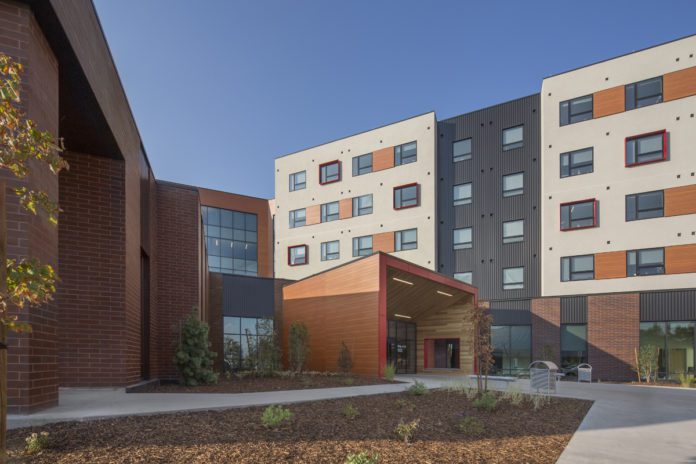
Last week took me to the University of Utah for the return of students to classes and the opening of Kahlert Village, a new residential complex conveniently located near the heart of the campus adjacent to the Huntsman Center. Parents and nervous new students unloaded their belongings and found their rooms, and I noticed a fair number of parents marveling that their dorms had looked nothing like Kahlert Village.
Pulling back and still looking at the main entry elevation, you can get a sense of the four wings expanding out from a central hub that house the four themed communities: the Gail Miller Community Engagement Tower; Heather Kahlert STEM (science, technology, engineering and math) community; the First-Year Honors Community; and the Patricia W. Child Health & Wellness Community. Okland Construction built Kahlert Village, and MHTN Architects designed it.
Looking at the village from the bike and pedestrian paths, two of the wings shelter a central courtyard where students eat their take-out meals on the shady grass. The dining facilities are on the ground floor to the right with the curving glass wall.
The dining area resembles a food court with the different options distinguished by design themes. Students can eat there or take food out with social distancing enforced.
The core of the village is an active central area with lounge area (the Fireside Chat is featured above), common work areas, tech tables, classroom set ups, a staffed front desk, music rooms, a Bennion Service Center and more.
This is the Adobe Creative Commons, located just off the lounge area where students can drop in for coaching on the Adobe apps and participate in presentations and trainings.
The students have a secure package pickup area, which makes sense for online shopping and boxes of cookies from home.
The meditation room is on the main floor in the Health and Wellness wing. There are two living walls, LED lights that I set to green, and a supply of mats and cushions.
Upstairs, each floor has a lounge and kitchen area. The ones I feature are in the STEM wing.
I photographed using available light and picked times when the areas were less occupied. I think some of the parents summed up the space pretty well when they said, “It makes me want to go back to school.”
One of the interesting things about having lived some years over what qualifies as youth is seeing things concurrently in the present and in the past. I spent twenty years of my youth living in Park City as it transitioned from a mining town to a ski town, and some of the last remaining miners lived on Rossi Hill among a few of the ski crowd. It was a location with wildflowers in the summer setting the scene for a happy mountain lifestyle, and it was an easy walk to get to the mines for work or down to Main Street to the saloons. Fast forward to now with the introduction of Lilac Hill.
Photo by Scot Zimmerman
There are still a couple of original tiny, tattered and sagging homes standing on Rossi, but time has moved on. Fortunately, the new homes in a Rossi Hill enclave called Lilac Hill preserve portions of the old homes and retain the charm, while still offering comfortable modern living in 3,000 square feet that the miners would think was worthy of the silver barons that owned the mines. Today’s featured home is one of four completed by a Park City team: architecture by Elliott Workgroup; building from Aerie Construction, interiors by Natural Instincts. Nomad Soul staged the home, which is for sale furnished. The location remains convenient to Main Street’s happenings, and it is on the bus line to get to Deer Valley or the Park City Mountain resort. Happily, the wildflowers are still blooming.
Photo by Scot Zimmerman
From the entry, the main middle floor is an open planned space with an open ceiling and generous windows. We’re looking toward the fireplace, which warms the space from the corner.
Photo by Scot Zimmerman
Looking back to the kitchen, the soft light tones of the wood floor continue into the cabinetry. Black metal repeats in the window frames, range hood, and stairway.
Photo by Scot Zimmerman
And speaking of stairways, I have previously admitted that they are my photographic weakness; I can never resist photographing a beautiful flight of stairs. I loved the graphic quality of the metal, wood and glass.
Photo by Scot Zimmerman
Upstairs is the master suite with another open-to-the-gables ceiling, and a sliding barn door to the bath with modern hardware and a pattern on the wood door that I found truly pleasing.
Photo by Scot Zimmerman
I am excited to show you this master bath. I am photographing the vanity from inside the shower enclosure. Note the different heights for the double sinks and the variation in the bowls.
Photo by Scot Zimmerman
The sculpted tub shares the same enclosure as the shower, which is behind me. It’s a wonderful use of space, and it might work well to rinse off after a bubble bath.
Photo by Scot Zimmerman
On the lower level is a space for cuddling on the sofa while watching movies or sports. Also on the lower level are three additional bedrooms.
The home was sufficiently lit by daylight. I had little need for additional lighting except for a little boost downstairs in the darkest areas.
This part of Park City used to be one of my favorites, and with the introduction of Lilac Hill, I’m happy to report that it still is. Time moves on: sometimes things are lost and many times things are gained.
The Baccarat from Raykon Construction. Photo courtesy Utah Valley Parade of Homes.
At this year’s Utah Valley Parade of Homes, builders and designers brought fresh ideas and elegant style to every part of the home, and the bathrooms are no exception. Bathrooms continue to deliver dramatic design with shapely tubs, spacious showers and decorative details as striking as those featured elsewhere in the home. With spaces this relaxing and beautiful, every night feels like a trip to the spa.
These freestanding tubs are strategically placed to allow homeowners to soak in the bath while taking in serene mountain views. Unique wall art and a luxurious chandelier only add to these spaces’ casual glamour.
Why leave it at plain white wallpaper? Bathrooms can be the perfect place to experiment with some unexpected patterns. In this bathroom, floral wallpaper adds some retro flair and a necessary splash of drama.
This bathroom embraces a classic black-and-white contrast with dark tile and light-colored countertops and cabinets. A bit of greenery adds an organic touch to the room.
Many of us default to boring bins underneath the sink, but thinking outside the plastic box can add the perfect finishing touch to a bathroom design. A wood stool and wicker basket are both practical storage containers and eye-catching decorative elements.
This bathroom boasts more of the intricate cabinetry featured throughout the rest of the home. A large rug gives the room a warm finish while echoing the ornate details of the other materials.
While remodeling a Holladay home, Cara and Tom Fox transformed an outdated dining room into something classic yet fresh, timeless but not overly traditional. Here, Cara Fox explains how specific elements in this room serve its spirited, fresh-picked style.
An Aerin Jacqueline chandelier adds huge scale and surprising style.
A bold stripe lends a fresh twist to traditional wingback chairs from One Kings Lane.
The drapery rod and Savannah sconces deliver the warmth and sheen of timeless brass.
Lemon topiaries from The Enchanted Home play off the wallpaper’s whimsical garden theme.
From windows to walls, Josef Frank’s “Citrus Garden” has been a decorators’ darling for decades. Among the fanciful prints that Schumacher commissioned Swedish designer Josef Frank to create in 1947, “Citrus Garden” became a decorator’s darling, so much so that interior designers began backing the fabric so they could cover walls with it. In 2017, Schumacher responded with wall-ready papers that coordinate with select Frank prints, taking them far beyond window dressing.
The Big Little House, by Anne-Marie Barton and Jackson & Leroy, was featured in this year's Salt Lake Parade of Homes.
Last weekend, the 2020 Salt Lake Parade of Homes finished showing off the best work from builders and designers across Utah. This year, the Parade included something for everyone, from a modern townhome to a classic remodel and a sprawling family estate to a tiny ski shed. Our favorite homes were in conversation with contemporary trends but weren’t afraid to display a distinctive sense of style, bringing their own unique, refreshing sensibilities to this year’s roster. Here are the highlights from the 2020 Salt Lake Parade of Homes:
We’ve been a fan of this one from the beginning. We featured this sparkling remodel from designer Anne Marie Barton and Jackson & Leroy last year, and the newly updated project, complete with a newly renovated lower level, was a big hit in this year’s Parade. Barton and her collaborators retained the timeless charm of this 1940s Sugar House property while adding pitch-perfect modern details. Some of the home’s most memorable elements include several show-stopping wallpapers, a brass-framed open shelf in the kitchen and a music room boasting a drool-worthy vinyl collection. This home may be little, but its bold style is anything but.
All photos from Salt Lake Parade of Homes.
The Millcreek Retreat by Unified Contractors
This one-of-a-kind home elevates the urban jungle to a new level. Using an eclectic range of influences, from the property’s mountain views to Disney’s “Jungle Cruise,” the Millcreek Retreat takes a walk on the wild side. Dominated by an earthy color palette of browns and greens, the playful design includes touches of the outdoors in every room. And who could resist this whimsical kids’ room, including a cozy teepee?
There’s not a spare inch wasted in this miniature home located near Big Cottonwood Canyon. At just 360 square feet, this minimalist’s dream is eco-friendly, sustainable and completely portable. This comfortable space has everything you need—though with the slopes so close, why spend your day lounging inside?
At 9,518 square feet, Mauna is the Parade’s largest home, and the space is an ideal home base for entertaining and family living. This Draper property boasts multiple kitchens and family rooms, a party-ready game room and a happily-ever-after child’s bedroom. Mauna, which translates to “mountain” in Hawaiian, appropriately features grand mountain views.