Heather Griffiths has a passion for the slow flower movement and its capacity to connect our communities. Photo by Rose Torres.
“I grow flowers for special moments and to make moments special,” says Heather Griffiths, whose love for local agriculture and growing communities inspired her to create the Utah Cut Flower Farm Association. The organization promotes local and sustainable flower growers as well as Utah’s slow flower movement. Whether you’re grabbing blooms or seeds to grow your own, Griffiths reminds us why buying local is the right choice.
Freshness
The short time it takes for local flowers to get from the farm to your table means they’ll stay fresh longer than grocery store bouquets.
Seasonality
Choosing local flowers means better variety and hardiness. “When you embrace seasonality, the quality of your flowers is above and beyond,” Griffiths says.
Local Love
Supporting your local flower farms makes a positive impact on your community.
Heather Griffiths is President of the Utah Cut Flower Farm Association, which supports local, sustainable flower growers. Photo by Rose Torres.
Environment
Flowers grown locally and organically use fewer resources, generate less trash and support a healthy ecosystem where they’re grown.
Connection
“When someone gets an arrangement of flowers grown just fifty miles from where they were born and raised, those flowers create a sense of connection and a sense of place,” Griffiths explains.
Where to Buy Local Flowers
To ensure you’re buying a slow flower arrangement, ask where the bouquet comes from, how it’s grown and who grew it. Contact your local farm to find, pick up or pick out blooms. Here are some local growers throughout Utah:
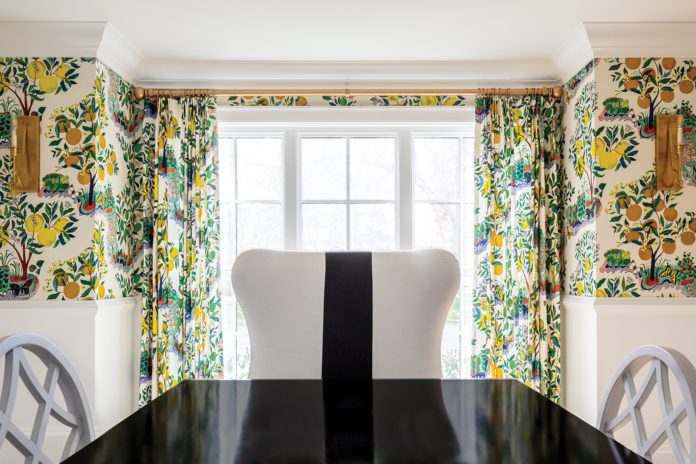
Designer Cara Fox framed the room’s new window with draperies tailored from the Citrus Garden wallpaper’s coordinate fabric. The matched look is very custom and is enjoying a huge comeback, she says. Photo by Lindsay Salazar.
Oh, that wallpaper! We understand if it leaves you momentarily spellbound. The same goes for the oversized beaded chandelier, the boldly striped chairs and the gleaming brass fixtures. Mesmerizing details flourish throughout the dining room of this Holladay home recently remodeled by Cara and Tom Fox, principals of The Fox Group.
Faced with the room’s original 8-foot ceilings, red oak floors and stuffy ‘80s décor, the homeowners gave Cara and Tom free reign to reimagine the outdated space, requesting something classic yet fresh, timeless but not overly traditional. “No problem,” said Cara, who opened her bag of design tricks and infused the dining room with joie de vivre, one element at a time.
The foyer’s black-and-white marble floor inspired the classic palette of the adjoining dining room, where white chairs surround a high-gloss black table and contrasting striped fabrics abound. Photo by Lindsay Salazar.
The dining room sits off the large entry and leads to the kitchen, where the Foxes broke through the home’s second level to give the kitchen a soaring, two-story ceiling. Unfortunately, that wasn’t an option for the dining room, so they used the room’s elements and décor to visually raise the low overhead surface. They began with the walls.
“We added a chair rail midway up the wall and placed Schumacher’s “Citrus Garden” wallpaper above it,” Cara says. “The paper lifts the eye and visually heightens the wall.” It also fosters the room’s spirited style, as does a surprisingly heroic chandelier. “I love it,” the designer says. “Many people would be afraid of putting a massive, eye-catching chandelier in a room this size, but it actually draws your attention away from the low ceilings.”
Cara Fox teamed with husband Tom to remodel and redesign this Holladay home. Photo by Lindsay Salazar.
For paint, Cara chose a tone of white—Benjamin Moore’s Swiss Coffee—to help make the ceiling appear higher and to dress the walls and trim in a classic hue. “It’s a warm white that complements the wallpaper’s yellows and oranges,” she says. Brass does the same, adding elan to gleaming sconces and a thick drapery rod that accents the window wall. There, French-pleated draperies frame the window in a print identical to the wallpaper’s. “Matched fabric and wallpaper is a very custom look that is making a massive comeback,” the designer explains.
The entry’s marble floor inspired a classic black-and-white color pairing that plays throughout the strikingly cheerful dining room. Chair cushions bring to mind wide-striped, black-and-white awnings that shade the windows of sun-drenched Mediterranean villas. Greek key carvings detail white, lattice-back dining chairs surrounding a glossy black table. At each end, single black stripes dramatically embellish winged host chairs. “Choosing host chairs that don’t match the side chairs makes the room feel less formal and predictable,” Cara explains.
To prevent the 8-foot-high ceiling from appearing low, Cara eliminated recessed can lights and painted the surface white. A surprisingly large and showy chandelier also draws attention away from the low ceiling, she says.The table seats twelve. To promote a bright, airy feel in the room, Cara chose lattice-back side chairs that allow light and views to flow through them. A pair of lemon topiary arrangements add immeasurable panache to the tabletop. Photo by Lindsay Salazar.
New white oak flooring, with planks measuring ten inches wide, reinforces the room’s fresh, casual style. “They modernize the room,” Cara says. The floors team with the room’s other carefully considered elements to fill it with fresh, classic style and ambitious shots of charm and whimsy. “This room just makes you smile,” she adds. And for her clients, that was what they had hoped for—and more.
For more decorating ideas and inspiration, click here.
Floral design from Artisan Bloom's spring collection. Photo by Logan Walker.
Against all odds, Artisan Bloom‘s new brick-and-mortar floral shop opened during COVID-19.
Kellie Jackstien, owner of Artisan Bloom, took a big leap by transforming a run-down space into a beautiful floral shop. Then, COVID-19 hit. Photo courtesy Artisan Bloom.
Artisan Bloom’s new location includes a consultation room, featuring their own fresh, inviting floral arrangements. Photo courtesy Artisan Bloom.
USD: What made you decide that Artisan Bloom was ready for a change?
Jackstien:I began searching for a design space for Artisan Bloom kind of on a whim. I knew I wanted to expand my company and felt like a beautiful, creative space for my designers to create and my clients to gather would add to the design experience synonymous to the Artisan Bloom brand. I wanted something that reflected my passion of transforming spaces. We do this all the time with our weddings, but transforming a design space was really exciting for me.
Floral design from Artisan Bloom’s spring collection. Photo by Logan Walker.
USD: How did you decide on the location for the new shop?
Jackstien:I purchased the building in December of 2018. I was looking for a true fixer-upper. I love transforming a space and was excited to find something with great bones in an up-and-coming area.
Jackstien was charmed by this Midvale location, but the building needed serious renovations. Here’s the interior of the shop on demolition day. Photo courtesy Artisan Bloom.
I was drawn to Old Town Midvale because I truly saw so much potential on this little tree-lined street. It’s quirky and charming. Enter 7573 S Main Street. Built in 1920, this building was NOT cute when I found it. Like, not at all. My friends and family thought I was crazy, but I saw potential and I knew given the era it was built, I might find some unique original details.
Jackstien transformed the entry, adding both a crystal chandelier and natural light from black-framed windows. She kept and restored brick from the original structure. Photo courtesy Artisan Bloom.
USD: Obviously, you know design. How did you narrow in on a renovation plan?
Jackstien:I had a killer Pinterest board that I was determined to execute in this renovation. We began renovation in August 2019. When we stripped the interior down to the four exterior walls, we discovered century-old brick, stick framing and duct work which I was thrilled to expose and incorporate into the overall design. Influenced by the 1920s era, we restored two original radiators and incorporated penny tile, marble top tables, bold brick and natural wood tones, layering in sparkling crystal chandeliers. Thank you Roaring ’20s for that contribution to design! After blowing the budget (a lot) and timeline (a little), we happily moved in December 2019 and prepared for our glorious 2020 wedding season to begin.
Jackstien hard at work in her new shop. Photo by Logan Walker.
USD: Boom! COVID-19 had other plans. How has your business changed since the pandemic started?
Jackstien: Within days of the announcement of a global pandemic, we learned that wedding season was put on hold indefinitely. It was a frightening prospect. With a design studio waiting for flowers and talented designers anxious to create, we brainstormed, Googled Shopify coding, designed, developed and shot content. With herculean efforts from our team, we opened an online shop featuring gorgeous, luxe floral designs worthy of gifting just in time for Mother’s Day.
The shop’s old exterior was dark, uninviting and worn-down. Photo courtesy Artisan Bloom.
Things have been going well with the online shop after Mother’s Day. Gifting is such a new territory for us and establishing a good footing can take years. We’re grateful for the support we’ve seen from our local clients and friends that associate a level of luxury with the Artisan Bloom brand. We’re seeing slow and steady growth, and it’s been such a fun shift for us.
The shop’s newly transformed exterior features a bold black-and white color palette, modern lanterns and large open windows. Photo courtesy Artisan bloom.
USD: COVID-19 has essentially cancelled the summer wedding season. How has that impacted Artisan Blooms?
Jackstien: Definitely there have been no big summer weddings this year which is a HUGE change for us. Fortunately, a majority of our wedding clients postponed to next year rather than cancelling and so far, 2021 is looking to be an incredible year.
Floral design from Artisan Bloom’s spring collection. Photo by Logan Walker.
A lot of our brides are choosing to elope on their original wedding day with a small, intimate but beautiful ceremony and gorgeous feast for immediate family and friends with a much larger and extravagant celebration the following year with extended friends and family. It’s been a fun way to extend their wedding celebrations. Nearly every bride I work with experienceswedding blues when everything is over. All the excitement and planning is over, and they just want to keep celebrating. This accomplishes that in a beautiful way. I think when all is said and done, people are going to want to celebrate in really big ways. I think everyone has really reconnected with the idea that life is short and our family and friends are such a gift. The idea of prioritizing experiences with them will hit a new level.
Floral design from Artisan Bloom’s spring collection. Photo by Logan Walker.
USD: How has this “pandemic pivot” worked (and not worked!) for your business?
Jackstien: We had a tremendous response to our online shop and on opening weekend, with the loving support of our loyal clients, our dear friends and excited industry partners, we sold out every design! We were so excited. The Artisan Bloom shop is here to stay. It’s been a creative haven in an uncertain time and we are truly grateful to our supportive community for believing in us. We continue to develop new designs that are striking and anything but basic. While we can’t wait to get back to weddings and events, we sure love the side venture of the Artisan Bloom Shop.
The shop’s new design space marries creativity and practicality. Photo courtesy Artisan Bloom.
I am so proud of my team. We went from a team of 50 to a team of six virtually overnight. The idea of not being able to keep my core team with me through this was unimaginable. We’ve become a bit of a family, and I didn’t want to lose that when we didn’t have the work to support the expense of a payroll. We’ve worked hard and we’ve reinvented a revenue source to sustain that. It’s not enough to be a long term solution at this point, but it’s getting us through and allowing us to wait this out together. And it has tremendous potential. We see growth every week and that’s impressive.
Floral design from Artisan Bloom’s spring collection. Photo by Logan Walker.
It hasn’t worked in that any business owner would tell you it’s nearly impossible to launch a new project without any capital in an overly distressed economy. Federal and state-funded disaster relief has been helpful for my employees, but not for me as an owner. Business owners will walk away from this with a significant amount of debt, and that’s hard to stomach, but the ones that make it through will be stronger and more resilient. After nearly 20 years in business, we’ve weathered bad economies and market crashes, but nothing quite like this. Our local market really needs to dig deep and support their local small businesses. Small business owners are throwing everything they have into keeping their doors open and their employees paid, and there will be some serious recovery years. Buy flowers, dine out, safely meet your friends for a drink, buy local, buy local, buy local. Consistent local support will go a long way in helping to climb this mountain.
Floral design from Artisan Bloom’s spring collection. Photo by Logan Walker.
USD: What makes Artisan Bloom’s floral designs so unique?
Jackstien:Everything we do is elevated. From our bloom selection and color stories, to our signature branded wraps and beautiful wax-seal enclosure cards, we want gifting to truly be an experience. We carefully curate seasonal collections, incorporating the most beautiful blooms. Everything we source is local, whether it’s from local farms or supporting local wholesalers. When launching this project, it was especially important to us that we support small local businesses impacted by Covid-19.
Creating a new home for Artisan Bloom was a family affair. Here, Jackstien’s family members take a lunch break during a day of renovations. Photo courtesy Artisan Bloom.
USD: What’s next for Artisan Bloom?
We have some down time now that wedding season is quieter than usual, which allows us time to start some new projects. We’re planning to launch a Wine and Design Night, where guests can rent out our beautiful studio and enjoy a night of wine and spirits pairing, gourmet bites featuring local caterers, old school jazz and professionally-guided floral design instruction with keepsake floral arrangement. Our 1920s building has such a beautiful, creative energy about it and we can’t wait to share it.
Floral design from Artisan Bloom’s spring collection. Photo by Logan Walker.
Find more stylish places—and the people behind them—here.
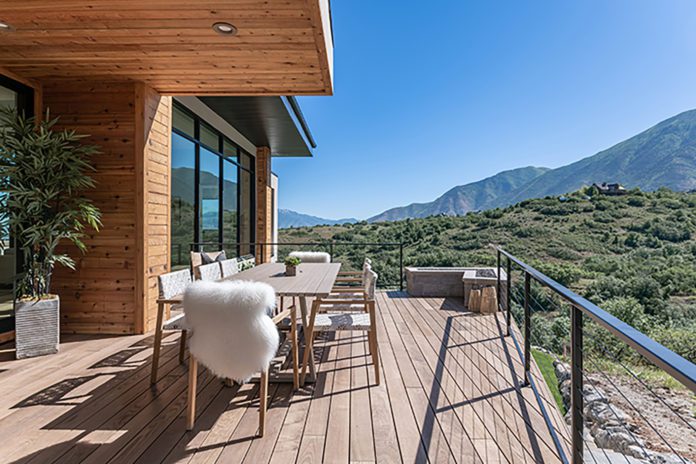
Located off the kitchen, the back deck performs as an outdoor dining space that melds comfort with the beauty of the surrounding mountains. “Patios were placed with the idea of getting morning sun adjacent to the kitchen, while evening patios and the hot tub deck favor the city lights and lake views,” architect Rob McQuay says. Photo by Rebekah Westover
For a designer with a stratospheric online following, Becki Owens is noticeably down to earth. So too, are her interiors. “I try to make design approachable,” says Owens, whose stylish, laid-back spaces have garnered her nearly 1.2 million Instagram fans. It’s no wonder then that the Utah home on which she recently collaborated with her brother Brett Boyce to create has such natural appeal. “I stay true to what I love,” she says. “Casual, yet current and always inviting.” Boyce, president of Split Rock Custom Homes, wasn’t Owen’s only team member. McQuay Architects’ Rob McQuay rounded out the trio of talented heavy hitters.
Interior designer Becki Owens with brother Brett Boyce, president of Split Rock Custom Homes. Photo by Rebekah Westover.
The home resides in Summit Creek, a community in Utah County’s Woodland Hills surrounded by breath-taking mountain scenery. McQuay Architects, based in St. George, is known for creating dynamic view-driven designs, and its work on this home is no exception. The spectacular setting inspired the dwelling from the get-go. “When we walked this property, we discovered that there was no single view to be captured,” McQuay says. With simple turns, visitors can gaze upon Loafer Mountain, Mount Timpanogos, Utah Lake and the city lights of Utah County. From the right vantage point, they can even catch a view of Mount Nebo. So which view do you favor? “Why not all of them?” McQuay replies.
Chevron-patterned black wood tile clads the great room’s fireplace, while white-oak floors flow seamlessly from the light-filled space into the nearby dining and kitchen areas. Wood tile and flooring are from Henriksen/Butler. Large, black-framed windows capture mountain views, and roller shades are hidden in the ceilings above. Photo by Rebekah Westover.
Architecturally, the hillside house steps down the site and features materials and colors that complement the landscape. “The house must be ‘of’ the hill, rather than ‘on’ the hill,” explains McQuay, paraphrasing Frank Lloyd Wright. He sloped the home’s roof lines upward toward the perimeter, continuing with exterior overhangs. In the great room, for example, a soaring, angled ceiling opens the space to grand scenes of Loafer Mountain. Similarly framed views fill the spaces and drive the design throughout the interior.
“I like to mix wood tones to avoid a one-note look,” says Owens, who paired warm wood tones with white-painted cabinetry in the kitchen. Cabinets are by Elite Woodwork. Photo by Rebekah Westover.
When asked to describe this hillside Utah home, Owens says, “It’s a mountain-modern home, but not so modern that it’s unapproachable.” She fostered this style with a mix of elements that travel easily throughout the home’s cohesive design. “Black accents, warm woods, light linen colors and loads of texture,” says Owens, describing her comforting palette. It moves seamlessly outdoors onto inviting decks and patios saturated with style and stunning scenery. “Anytime we start a home, we start by looking at what is going on outside and then blur the lines between indoor and outdoor,” Boyce says. Owens agrees. “The flow of indoor to outdoor can be super cohesive and we consider it from conceptualization.”
“Every patio space is designed, decorated and furnished like an indoor space,” Boyce says. This seating area is located next to a hot tub deck surrounded by views. Photo by Rebekah Westover.
It’s not surprising siblings Owens and Boyce are on the same page, design-wise. “We grew up with design all around us and construction is in our blood,” Boyce explains. Both were raised in Farmington where their father Ren Boyce owned a hardware store, with offerings that included home-décor products. “My parents also bought and remodeled homes, and we were part of that growing up,” Owens adds. Over the years, the burgeoning hardware business spread across the state when Ren sold it. He and his wife Debi moved to St. George, where Ren invested in the Entrada community. There, Ren began building homes and became a founding member of Split Rock Custom Homes.
In the open kitchen, Owens hung Hudson Valley lanterns above an island topped with quartz. The material also forms the backsplashes and range hood. “People like it for its durability,” she explains. The designer placed a cowhide rug beneath the dining table to add an organic form that counterbalances the hard lines and corners of the table and expansive windows. Photo by Rebekah Westover.
Following college and a slew of corporate jobs, son Boyce joined Split Rock and learned the business from the ground up before eventually becoming its president. Meanwhile, Owens graduated in community health, worked for an interior design firm and began a successful lifestyle blog. Today she and her young family live in California, where she runs a thriving interior design business and curates her wildly popular online content. “I just kept rolling with it,” she says, describing her astronomic success in design while simultaneously starting and raising a family.
Owens accented black bunk beds with bold, brass support rails and hardware. She painted the back walls black to unite the bunks with the nearby wall-mounted desk and open shelves. A Moroccan rug adds texture and warmth to the innovative space. Beds crafted by Elite Woodwork. Photo by Rebekah Westover.
This is the third home that Boyce and Split Rock have built in Summit Creek, and the first home that he has teamed with Owens to create. He hopes for many more. “I have always wanted to work with Becki. She is so talented and amazing at visualizing the end product,” he says. “She nailed it, as did Rob.” Owens is equally enthusiastic about a repeat performance. “Brett is super easy to work with. He is very detail-oriented and understands the importance of quality,” she explains. This project proves that talent and collaboration is a winning combination. Add a stunning setting, and it’s clear the home was destined to be a triumph, from any point of view.
“Sometimes white and black can feel too stark, so I used wood on the master bathroom’s ceiling to add warmth and texture,” Owens explains. A glass shower wall and organically shaped globe light foster the room’s clean, light-filled ambiance. Photo by Rebekah Westover.
Fueled by community donations, Park City's KPCW is back with a reimagined office space. Photo by Scot Zimmerman.
There are many things that weave a community together, and in Park City, KPCW public radio is a strong force. It’s where you find out about what’s happening locally, learn who might need some help, and pair the lost with the found, whether it is a wandering Labrador or a pair of skis left on the bus. KPCW also relies on volunteers to host shows and help with the work of the station. If there is any question about how much Park City relies upon and appreciates KPCW, the proof is the enlarged and remodeled station funded by donations from the community.
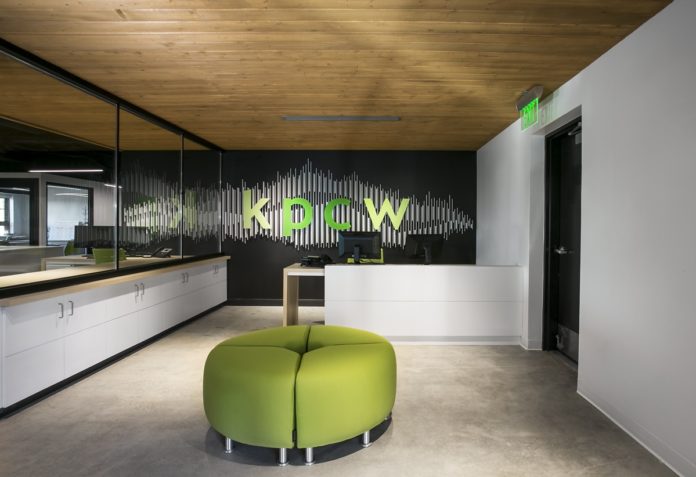
The office remodel includes a more open and accessible front entrance. Photo by Scot Zimmerman.
For some time, the station has been located on the second floor adjacent to the China Bridge parking structure on Swede Alley. The door was rather secretly located at the back, and operations were squeezed into a space with winding narrow hallways and not much space for anyone or anything. Architect Carla Lehigh, from Elliott Workgroup, pushed out toward the sidewalk for more space and created a wide stairway and front lobby entrance.
Pillars allow for an expansion of the original space. Photo by Scot Zimmerman.
The expansion also pushed out to the north. The extension sits on pillars above patio space for the State Liquor Store in the space below. In this view, the stairway to the left leads to the parking garage and to the original back entrance.
Inside, large windows provide a view of the city’s famous mountains. Photo by Scot Zimmerman.
A volunteer DJ is at work in the broadcast booth with views to Old Town and the ski mountain. Park City is at the center of important cultural happenings in Utah, and the new building has an interview space to bring groups of people together for hosted conversations and facilities for groups to perform live music. I’m usually tuned into KPCW during the Sundance Film Festival, and I’m excited that it will be much easier to capture the interviews they broadcast.
The new, larger hub for KPCW is a perfect space for local DJs, celebrity interviews and even intimate live performances. Photo by Scot Zimmerman.
This new KPCW has both private offices and a flexible central workspace. Celadon green chairs pick up the green from the KPCW’s logo. Photo by Scot Zimmerman.
Tricia Janes of Elliott Workgroup designed the efficient flexible workspace with private offices. The LED lighting lends a graphic element, the low-wall planter defines circulation, and the celadon green chairs pick up the green from KCPW’s new logo. With this wonderful new space thanks to the supporters in the community, I’ll send my wishes that they keep up the great work!
Your yard deserves more than a shoddy shack crammed with tools and garden gadgets. So do you. These 15 ideas will inspire you to turn your cluttered potting shed into an organized workspace rooted in style.
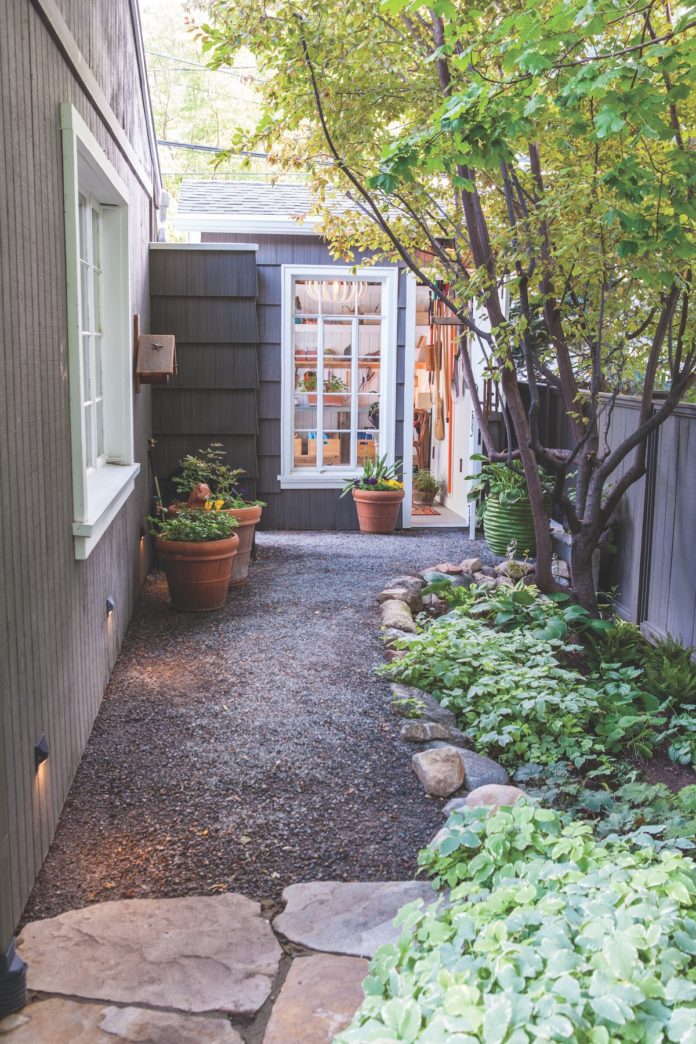
1. Your shed’s exterior can complement your yard and home. In the potting shed pictured above, shake siding and white trim nod to the property’s main house and help make the small building an eye-catching focal point in the corner of the backyard.
2. This space doesn’t have to be dark and dreary. A small skylight makes a big difference by directing daylight into the workspace.
3. Transform materials into something new. Repurposed fencing from a landscape overhaul clads the pitched ceiling in rustic charm.
4. Include a few unexpected, eye-catching details to liven up your shed. A bentwood pendant light delivers a surprising design element to the space.
5. Order is key in a small area with lots to keep track of. A row of high hooks organizes tall tools and keeps them off the floor.
6. Make sure commonly used items are organized and accessible. Easy-to-grab garden hats mount on simple wall hooks.
7. Let the outside in. Windows salvaged from a home remodel deliver charm and light to the shed’s interior.
Photo by Adam Finkle.
8. Emphasize an elevated version of classic style. Tongue-and-groove wall paneling fosters a charming cottage look.
9. Use every inch of wall space. Open shelves provide easy-to-access storage space above the work bench, while freeing up floor space for large, heavy items.
10. A few simple furnishings can make all the difference. A castaway bentwood stool, small table lamp and old radio furnish a cozy corner workspace.
11. Available at craft and hardware stores, wallet-friendly containers including wood crates, bushel baskets, wicker wall caddies and glass jars become handsome organizers and storage solutions.
Photo by Adam Finkle.
12. Smart categorization is key to keeping your shed clean. Common-purpose tools, fertilizers and seeds are separately stored to promote organization.
13. Get creative with materials. Old fence posts form the base of a mobile, stainless steel-topped potting bench set on casters.
14. With a creative twist, scraps can be repurposed into simple and useful storage. Long-handled tools are kept in a mobile tool caddie crafted from leftover lumber.
15. Don’t be afraid to play with bold shades. A braided rag rug softens the space and adds a lively pop of color.
Photo by Adam Finkle.
Looking for garden inspiration this summer? Click here.
Floor-to-ceiling tile clads the back wall, drawing the eye into the wet space and accentuating the high peaked ceiling and large trapezoid window. A curbless entry into the wet space fosters the room’s seamless design and enables an unobstructed flow of the floor tile throughout. Photo by Rebekah Westover.
Master bathrooms have always played a supporting role in the cast of a home’s most prized spaces, but these days, they often find themselves in the spotlight. Count designer Tonya Olsen among their biggest fans. “The master bath is the home’s most important room, only behind the kitchen and great room areas,” Olsen says. “What’s more, it is your own private space, so it deserves to be amazing.” Her conviction explains the striking design and details she used to give this space star status within a Park City home she teamed with builder H2 Homes to create.
Crafted by Rustica, a wall and barn door composed of steel and glass enclose the wet space without closing it off visually. Large porcelain slabs resemble marble, offering a wallet-friendly alternative to real stone. Veining visually balances the room’s hard lines. Photo by Rebekah Westover.
The master bathroom is composed of function-driven zones including a main vanity area, a make-up vanity and an enclosed “wet space.” Olsen didn’t look far for inspiration when determining the room’s design. “I wanted to create a seamless flow from the main level’s other spaces, so I reintroduced many of the forms, finishes and materials we featured in the great room and kitchen.” The shower-and-tub area’s tiled back wall, for example, mimics the dark-tiled form of the great room’s fireplace. The home’s main stairway features glass and black steel similar to those of the bathroom’s glass-paned barn door. In turn, this transparent barn door nods to sliding wood versions opening to numerous bedrooms. To further the cohesive look and feel, Olsen chose a single paint color for the entire home, including the master bath. Benjamin Moore’s “Simply White” covers all walls and ceilings. “It’s a classic white. It isn’t creamy, but it has a little warmth,” she explains.
Stephanie Holdaway and the team at Gatehouse No. 1 cleverly used a dark cutting board to serve as a bathtub caddy. Photo by Rebekah Westover.
The designer’s taste for mixed materials also drove countless details. “Assortment fosters a comfortable look and feel,” she says. Olsen clad the bathroom’s floor in oversized, stone-look porcelain tiles that seamlessly unite all areas of the room. White quartz—chosen for its simplicity and resemblance to the freestanding white tub—frames waterfall-style, dark-stained white oak vanities. “The contrast of dark and light accentuates their modern forms,” she explains.
Olsen set the bottom of the makeup vanity mirror at countertop level. “You don’t want to have to look above a backsplash to see yourself while sitting,” she explains. Photo by Rebekah Westover.
The designer covered the wet space’s back wall—floor-to-ceiling—in dark, large-scale tiles. She used the same tile to frame expansive, marble-look porcelain slabs mounted on the two adjoining side walls. “The marble veining helps soften the room’s straight lines and hard edges,” Olsen says. Chic, cylindrical glass pendant lights do the same as they gleam in front of large, frameless mirrors. “Some people like individual mirrors over sinks, but these reflect the entire shower area and make the space feel twice as big.” Olsen designed the mirrors so their tops horizontally align with those of nearby tile panels in the wet space. “This creates a continuous line that helps unify the space,” she explains.
Thick, white quartz frames the waterfall-style vanity. “I wanted it to be a piece of furniture that anchors the space,” designer Tonya Olsen explains. Dark-stained white oak drawers feature recessed pulls. “I didn’t want the distraction of hardware,” Olsen says.
These and many other carefully considered details deliver the style and comfort Olsen envisioned from the start. Not surprisingly, they also helped raise the room’s level of esteem she feels it and every master bathroom deserves.
Explore more of our favorite bedrooms and bathrooms here.
Cuisine and styling by Blended Table. Photo by Jessica White.
The Blended Table, a boutique caterer in SLC, knows how to prepare and plate spectacular fare. This meze, pictured above, proves it. Created for casual, communal grazing, the offerings are irresistible. “It gives guests the chance to try things that they might not try on a big plate,” says Emery Lortsher, co-owner.
Maybe it’s the large Greek population in Salt Lake City that accounts for the town’s welcome to the world—it’s a culture of hospitality. It’s certainly the reason we have so many great Greek and Mediterranean restaurants. And every one features a Greek appetizer, or meze, platter. Composed of an assortment of dips, cheeses, olives, fruit, bread and tomatoes, a platter is easy to put together and perfect for summer entertaining.
Are you ready to prepare meze for your next summer gathering? Serving meze stylishly is easy when you’ve got the goods. These should get you started:
Do you need a last minute dish that will wow everyone at a pool party? You can’t go wrong with recipes featuring watermelon, everyone’s favorite summer fruit. This eye-catching twist on a charcuterie board is delicious and easy to make—plus its color palette is a patriotic red, white and blue.
Let watermelon be the star of the show with these pretty and tasty recipes.
Ingredients
½ medium watermelon, cut into a combination of wedges and cubes ½ cup raspberries 1 ½ cups blueberries 5 ounces goat cheese ½ cup toasted salted cashews 2 ounces various cured meat, like prosciutto, pancetta, coppa, salami, soppressata, sausage or pepperoni 1 honeycrisp apple cored and sliced Lemon juice Fresh basil
Directions
Arrange the ingredients on a large board or platter. Drizzle all the fruit with lemon juice. Garnish with a few basil leaves. Serve and enjoy!
Cups of refreshing homemade watermelon granita with mint.
If you can’t get enough watermelon, we have a whole barbecue’s worth of mouthwatering watermelon recipes. Try cooling down with this watermelon granita recipe. It takes just three easy steps to serve this refreshing semi-frozen treat.
Watermelon pizza topped with shredded coconut, chopped mint, mixed fresh berries, greek yogurt and slivered almonds.
These watermelon pizzas can be a light dessert topped with greek yogurt, slivered almonds and shredded coconut. Or, transform this sweet fruit into a savory snack with goat cheese, prosciutto and balsamic glaze.
Watermelon pizza topped with goat cheese, arugula, prosciutto and drizzles of balsamic glaze.
If you’re firing up the grill, don’t leave it at burgers and dogs. Toss on some sliced watermelon, pair it with a kale salad and serve your guests a unique, healthy dish.
Sweet and smoky grilled watermelon balances nutrient-dense and bitter kale, topped with a dressing of olive oil, balsamic vinegar, garlic and honey.
If you don’t have much time to prepare an appetizer, have everyone do the work for you. Bring cheese, meat, veggies and fruits for guests to make their own skewers. Build-your-own-skewers are perfect for large groups—plus, they’re an easy way to experiment with unexpected flavor combinations, like fresh watermelon and boiled shrimp.
Skewers pictured (top to bottom): Grape, blue cheese, dried fig; Watermelon chunk, boiled shrimp; Basil leaf, black olive, Creminelli salame; Grape tomato, basil leaf, bocconcini: Apple chunks, ham cube; Prosciutto, canteloupe; Bocconcini, black olive, basil leaf, bacon; Clementine sections, chocolate truffle
For something to drink, try this pair of cocktails—one for the day and one for the night—featuring watermelon gastrique, a syrup of caramelized sugar, vinegar and fruit.
These summery cocktails combine watermelon gastrique with St. Germaine, Wahaka Mezcal and local Beehive vodka.
A cocktail gastrique calls for caramelizing the sugar, then adding vinegar and fruit. This version comes from Park City’s Silver Star Cafe.
With a little creative thinking, watermelon can be the star of the show in all kinds of perfect summer dishes. Have fun and stay safe this Fourth of July!
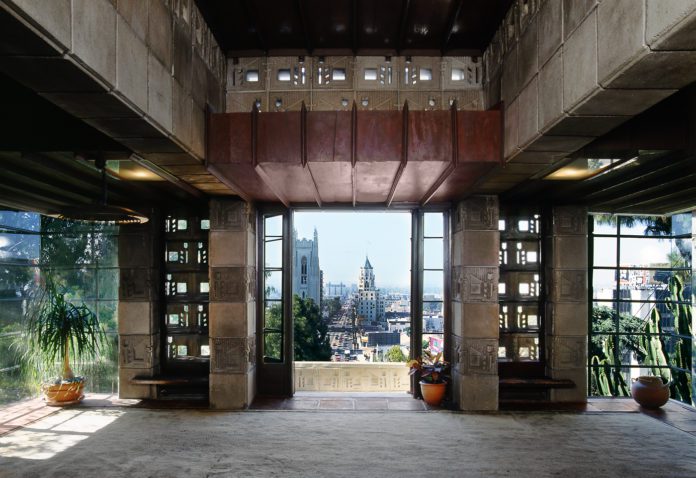
I recently received a call to use some of my photos to promote conservation efforts for the Freeman House in Hollywood. I think you will find this home interesting, and I can help you understand the urgency many feel to save the home. In the opening shot, the balcony doors open to frame a view of Highland Avenue. The perforated blocks with glass and the horizontally mullioned windows continue the views to Hollywood and the verdant Southern California landscape surrounding the home.
In this living room with its views and soaring ceilings, owners Samuel and Harriet Freeman hosted dinners and salon evenings with dazzling guests from the arts, the entertainment industry, architecture, culture and politics, beginning with the home’s completion in 1924 and continuing for decades.
Photo by Scot Zimmerman.
The Freeman House is the fifth and last of the knit-block homes that Frank Lloyd Wright designed and built in the Los Angeles area. First was the Aline Barnsdall House, better known as the Hollyhock House because of the hollyhock motif in the concrete blocks, which was completed in 1921. The Freemans were dinner guests in the Hollyhock House, and it inspired them to commission Wright to design their own home, the smallest of the block homes on a modest, steep site. In the photo, the home appears as one story, but it steps down the hill in two more levels. Sources estimate the size of the home as 1,500 square feet.
Wright’s LA block homes exhibit pre-Columbian architectural influences with their massive masonry and are said to recall the temples of the Mayans and Aztecs. The material is concrete, and Wright instructed that for all the block houses in Los Angeles, sand from the site be used for the concrete mix so that the color and texture of sand would be indigenous to the site. Unfortunately, the impurities in the sand resulted in the blocks not holding up over time. The knit-block system consisted of two parallel rows of concrete blocks separated by an air cavity with steel reinforcements rods tying the walls together vertically and horizontally. Blocks varied in surface treatment: smooth, patterned, or perforated patterns.
Photo by Scot Zimmerman.
Approximately 12,000 cast concrete blocks make up the Freeman House. David Gebhard, the architectural historian who collaborated with me in the late 1980s on Romanza, the California Architecture of Frank Lloyd Wright, commented that it was the most adventurous of the homes. “Wright realized a concrete block dwelling that was light, airy, and delicate, aspects not usually associated with this material,” he said.
Photo by Scot Zimmerman.
Wright created a unique design for each home’s blocks. There is no general agreement about the meaning of the blocks’ designs. Some call it the tulip, and I heard another theory that it represents the plan of the house, including a eucalyptus tree that Wright called out to be planted.
Another characteristic of this home is the integration of landscaping into the home’s design, including its patios and balconies. Frank Lloyd Wright’s son Lloyd Wright, who was trained in landscape architecture, managed the project and oversaw construction.
Photo by Scot Zimmerman.
The entrance to the home is typically Wright in that it is not at all obvious. Here, one goes down the stairs to discover the front door to the right.
Photo by Scot Zimmerman.
One enters a long, low, narrow hallway where the wood slats follow the lines in the courses of blocks to maintain a strong horizontal character. The feeling of compression releases when entering the soaring height of the living room.
Photo by Scot Zimmerman.
The hearth, as is typical of Wright’s work, is the heart of the home. The first photographs I made were in the 1980s, several years after Mrs. Freeman’s death and donation of the home to the University of Southern California. The Architecture department was charged with managing and restoring the home and used it as a laboratory for the students, who lived in the space.
My friend Al Struckus, an architecture enthusiast who was especially knowledgeable about organic architecture and architects of Southern California, accompanied me on the first shoot. Struckus was somewhat dismayed about the condition of the modernist architect Rudolph Schindler’s custom designed furniture in the living room and the detritus. He and I straightened it up as best we could. The Freemans had hired Schindler as their architect after the home was completed. He had previously worked for Frank Lloyd Wright’s studio and had been the superintendent of the Hollyhock House construction. Schindler redesigned parts of the kitchen and designed some paneling, display cases, light fixtures and the seating and tables.
Photo by Scot Zimmerman.
The tall narrow iron lamp on the left side is one of several that Frank Lloyd Wright designed for the home. Glass between the perforated blocks allow additional light into the home. The windows’ horizontal mullions continue the horizontal lines of the blocks. The corners of the glass are mitered: the glass comes together without any framing to continue the horizontal lines uninterruptedly and to allow an unobstructed view out the corner. At the time, this was considered very advanced technology. Originally, the mullions were made of wood, but later John Lautner, another famous Los Angeles area architect friendly with the Freemans (and also a Wright apprentice), had the wood replaced with steel. With today’s advances in window technology, I have been curious about how Frank Lloyd Wright would have incorporated these windows into his designs.
Photo by Scot Zimmerman.
Photo by Scot Zimmerman.
I returned to the Freeman House to make additional photographs for a book collaboration with Judith Dunham in the mid-1990s, and it had been severely damaged by the Northridge earthquake in 1994. Additionally, it appeared more neglected. The furnishings had been removed to storage, and access was restricted because it was unstable. Robert Timme, the Dean of the USC School of Architecture, later initiated a three-phase rehabilitation program, but sadly he passed away before beginning the third phase.
I am unaware of further work on the home. Last year, the Los Angeles Times reported that the Wright lamps and Schindler furnishings had disappeared from the USC warehouse.
I am pleased that efforts are renewing to draw attention to the Freeman House and to call for restoration. It was only a year ago that a number of Frank Lloyd Wright buildings were listed as UNESCO heritage sites.
Two years ago, I was contacted by preservationists for photos of Frank Lloyd Wright’s Lockridge Medical Center in Whitefish, Montana. Despite their hard work, the building was destroyed.
I am hoping for a better outcome for the Freeman House. It is not only a Frank Lloyd Wright design with Rudolph Schindler touches, it is also part of the history of Hollywood because of the Freemans’ role in gathering together notable people of the time.